Questions about cilia

Q.I just had a quick question with regards to cilia configuration. On the slide it states that cilia insert into basal bodies with 9 triplets of microtubules. Does that mean 3 axoneme are bundled into a unit and a cilia contains 9 of those units (so a total of 27 axoneme in one cilia)?

A. The arrangement of microtubules at the insertion point into the basal body is a confusing (and mysterious) feature of cilia. So you’re right on in trying to make some sense out of it!

No – the axonemes aren’t bundled in threes – there is just one axoneme (with its characteristic 9 + 2 arrangement of microtubules) per cilium. But you’re right about the insertion point: each cilium inserts into its basal body with an arrangement of microtubules consisting of 9 triplets (and no central pair).

Just exactly how the 9 + 2 arrangement of microtubules in the axoneme changes to the 9 triplet arrangement at the basal body is unclear – there isn’t a consensus on how the transformation happens. So you’re right to wonder about it! Unfortunately, there isn’t a good answer – but at least now you know you’re not missing something important.

Q. In lecture we talked about apical structures such as microvilli and cilia. It says that cilia are inserted into basal bodies, what are those? They aren’t part of the basal lamina even though it has the word basal correct? I am a bit confused because they are apical structures.

A. Great question! The term basal means “bottom” – and we throw it around a lot! In “basal bodies” basal refers to the bottom of the cilium! So basal bodies are little structures at the bottom (base) of each cilium. Basal bodies are the places where axonemes (the central structures of cilia) start growing; they also serve as anchoring structures for the completed axonemes. So yes: the basal bodies are apical structures, and they are not part of the basal lamina.

Q. Why are the 2 central microtubules not a pair but the 9 pairs on the outside are considered pairs (instead of 18 microtubules) in the cilia? Is that because they are of a different type?

A. Thank you for bringing this up! It is confusing that we call this a “9+2” arrangement when it looks like there are 9 pairs of microtubules around the outside, and one pair of microtubules in the middle! Seems like it should be either “9+1” or “18+2.” There’s a good explanation, though. Here’s a diagram of an axoneme – we’ll talk about the “2” part and the “9” part separately below.

The “2” part of the axoneme
The two microtubules in the center of the axoneme are totally separate from each other. So they can be considered to be 2 separate, independent units.

The “9” part of the axoneme
The 18 microtubules around the outside are bound together, two at a time – so they can be thought of as 9 separate, independent units.

It turns out that in each of these 9 units, one of the microtubules is incomplete. If you look at the microtubules circled in red, you can kind of see that the top one looks round, and the bottom one looks like it’s not quite round, and has sort of just latched on to the top one. The bottom one is actually not a fully-formed microtubule (if you pulled the two apart, the top one would be round, and the bottom one would look like a C-shaped structure). So we really shouldn’t even call these guys “pairs” since they don’t consist of two fully-formed microtubules. The official name is “doublet” – and that is a little better than “pair,” I guess.
Question about identifying epithelial cells in tissue specimens

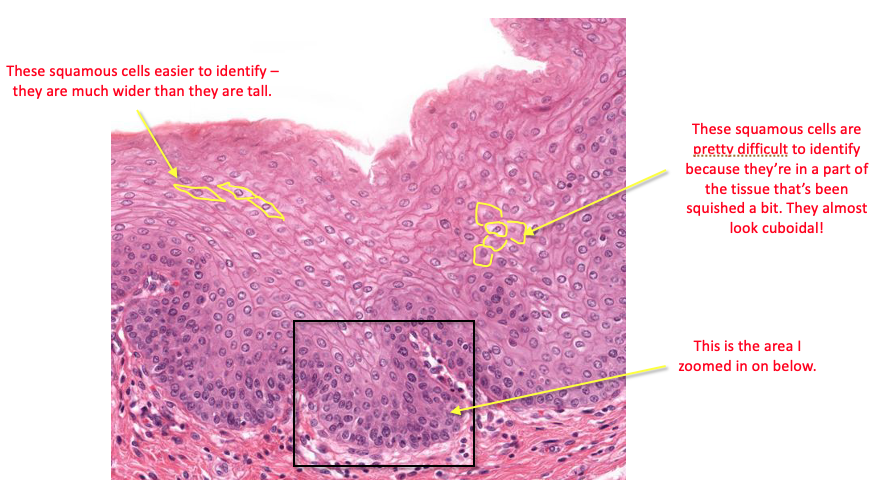
Q. Some of the cells in the stratified squamous epithelium on slide 53 look thicker and almost cuboidal while cells of stratified cuboidal epithelium on slide 54 are almost squished like squamous (especially around the folds in the lining), making them hard for me to distinguish them if I were to be asked without context of where they’re from. What is the typical process in distinguishing the epithelium type of real tissue specimens?

A. I totally get that! It can be really hard when you’re looking at these specimens for the first time; I remember feeling like I could tell what was what if it was pointed out to me – but if I had a slide without arrows, I felt lost.

I think that telling these types of epithelium apart – like many of the new things you’ll be looking at in this course – just becomes easier over time. We’ll see lots of examples of epithelia in all the different organ systems we go through – and you’ll soon get the hang of identifying different types of epithelium (squamous vs. columnar vs. cuboidal; simple vs. stratified), and pretty soon you won’t even have to think about it 🙂

I won’t be showing you pictures on the exam – so you don’t need to worry about being able to identify structures in actual images. I may ask you what a squamous cell looks like – but a lot of my exam questions are related more to the functions of structures (e.g., what is the function of the zonula occludens and how is the zonula adherens different?) I’ve posted some sample exam questions, so take a look at those to see how I tend to write my questions.

Back to your questions on the images – I made some notations to show you how I would know that the cells are squamous vs. cuboidal. Here is slide 53 with some comments:

Questions about glands

Here are some great questions about glandular cells!

Q. I wanted to clear up some confusion I have about glands and glandular cells types. I understand that there are 3 different glands; merocrine, holocrine, and apocrine. Within these glands with specific processes of secretion, there are different kinds of glandular epithelial cells; ion-transporting, serous secretory, mucous secretory, neuroendocrine, and myoepithelial cells. Is this correct?

A. Not quite! You’re correct in saying that based on their method of secretion, there are three types of exocrine glands (merocrine, holocrine, and apocrine). And you’re also correct that there are different types of glandular cells (ion-transporting, serous secretory, etc.).

However, not every gland can be classified as merocrine/holocrine/apocrine! In fact, that’s just one way of looking at/classifying glands – there are actually three different classification schemes, and they overlap with each other sometimes! So it can be kind of confusing at first.

So let’s look at the three ways glands are classified, and then we’ll talk through some examples. Here are the three ways you can classify glands:

1. By the presence or absence of ducts

  • Exocrine glands (have ducts)
  • Endocrine glands (do not have ducts)

2. In exocrine glands, by the method of secretion 

  • Merocrine glands (secrete using exocytosis)
  • Apocrine glands (a portion of the cell is lost during secretion)
  • Holocrine glands (the entire cell is lost during secretion)

3. In exocrine glands, by the nature of the secreted substance

  • Serous glands (secrete a thin, watery substance)
  • Mucous glands (secrete a thick, viscous substance)
  • Mixed serous and mucous glands (secrete both substances)

Sometimes we use all three classification systems when describing a particular gland – but sometimes we just use one or two of them, and leave out the others. For example, some exocrine glands have both merocrine cells and apocrine cells – which means they can’t really be labeled as either merocrine or apocrine.

So you’ll notice when we start talking about glands in different organ systems that we just classify them according to which of the three systems makes the most sense. In the pancreas, for example, we use the labels “exocrine” and “endocrine,” and for the exocrine glands, we also use the labels “serous” and “mucous” – but we don’t use the merocrine/apocrine/holocrine labels.

So the bottom line is that for now, all you need to do is understand the three classification systems above so that when you encounter these descriptions in the future, you’ll know what they mean. But don’t worry about fitting all three classification systems together, because they are used independently of each other.

Q. Can multiple kinds of these cell types exist within a specific gland? For example, can neuroendocrine and mucous secretory cells compose the same apocrine gland?

A. Yes! You can have neuroendocrine cells and mucous secretory cells in the same exocrine gland.

However, as mentioned above, note that these cell types may have different secretion methods (e.g., the neuroendocrine cell may use merocrine secretion, and the mucous secretory cell may use apocrine secretion). If this is the case, then you wouldn’t label the gland “apocrine” – you’d just not use any of the merocrine/holocrine/apocrine labels.

Q. Does the specific glandular cell “take on” the mode of secretion of the gland it composes? For example, would a neuroendocrine cell of a merocrine gland exocytosis its product at the apical end of the cell?

A. Great question! The short answer is no 🙂 If you had a gland composed mostly of cells using merocrine secretion, but it also had some cells using apocrine secretion, those apocrine-secreting cells would not “take on” the merocrine secretion method! They’d just continue to use their preferred apocrine method – and you wouldn’t be able to slap a merocrine, apocrine, or holocrine label on that gland 🙂

The mode of secretion of a gland is determined by the type of cells that are in that gland. So if a gland is made up of cells that use merocrine secretion, it’s called a merocrine gland. If the cells use holocrine secretion, you’d call it a holocrine gland.

Q. Do myoepithelial cells technically secrete any kind of product?

A. No – they typically don’t secrete anything. They’re located around the perimeter of the gland, “hugging” the glandular cells, and their job is to contract and help the glandular cells secrete their products.

Questions on Epithelium lecture

Q. I wanted to inquire as to whether you will have histology slides or pictures on the exams.  If so, I want to ensure that I can identify pseudostratified columnar epithelium.  If we see epithelium that looks columnar and looks stratified will it always be pseuostratified?  Is there stratified columnar epithelium or only pseudostratified for the columnar cells?  Or will you present a picture where we can always see that the cells touch the basement membrane?

A. Our exams won’t contain histologic images. But it’s a good idea to get the concepts straight, though, like you are – because our exam questions often refer to histologic findings.

There is both stratified and pseudostratified columnar epithelium – and as you mentioned, in stratified epithelium only the bottom layer of cells touches the basement membrane, but in pseudostratified epithelium, every cell touches it.

This is a perfect example of something that I think would be fair game for an exam question (in text format) – but unfair for a photo on an exam (because stratified and pseudostratified can look very similar!). So to test you on this concept, I might ask something like: “Which of the following characteristics is true of pseudostratified epithelium?” And the correct answer would be: “Every cell touches the basement membrane.”

Q. I just had a quick question regarding one of the 5 glandular epithelia cells that we discussed in lecture today. With Ion transporting cells, the figure (to me) shows sodium being absorbed. Do these cells end up working in both directions, by transporting another ion out of the apical end of the cell?

A. Yes! Usually there are ions going in both directions – for some reason, this diagram just shows sodium entering the cell. Often, the movement of ions requires ATP-dependent pumps – so that’s why there are so many mitochondria in these cells.

Q. We talked about how the basement membrane can be highlighted using the PAS stain, is that because it contains sugars in the perlecan layer of the lamina densa in the basal lamina? I know in past lectures that was one of the characteristics of PAS staining, so I wanted to double check!

A. Yes! That is a big part of it (and it is really the only sugary thing we talked about in the basement membrane!). There are also some additional sugar-containing substances in the reticular lamina – but I didn’t want to make you start memorizing all of them. In addition, basement membranes in different parts of the body may have additional components (the basement membrane in the glomerulus of the kidney, for example, is insane).

But back to your question: yes – the perlecan that we talked about in the lamina densa would stain nice and magenta with the PAS stain because it’s a proteoglycan, and therefore has nice sugar residues.

Q. In lecture we talked about apical structures such as microvilli and cilia. It says that cilia are inserted into basal bodies, what are those? They aren’t part of the basal lamina even though it has the word basal correct? I am a bit confused because they are apical structures.

A. Great question! The term basal means “bottom” – and we throw it around a lot! In “basal bodies” basal refers to the bottom of the cilium! So basal bodies are little structures at the bottom (base) of each cilium. Basal bodies are the places where axonemes (the central structures of cilia) start growing; they also serve as anchoring structures for the completed axonemes.

So yes: they are apical structures, and have nothing to do with the basal lamina.

Question about the 9 + 2 arrangement of the axoneme

Q. Why are the 2 central microtubules not a pair but the 9 pairs on the outside are considered pairs (instead of 18 microtubules) in the cilia? Is that because they are of a different type?

A. Thank you for bringing this up! It is confusing that we call this a “9+2” arrangement when it looks like there are 9 pairs of microtubules around the outside, and one pair of microtubules in the middle! Seems like it should be either “9+1” or “18+2.” There’s a good explanation, though. Here’s a diagram of an axoneme – we’ll talk about the “2” part and the “9” part separately below.

The “2” part of the axoneme
The two microtubules in the center of the axoneme are totally separate from each other. So they can be considered to be 2 separate, independent units.

The “9” part of the axoneme
The 18 microtubules around the outside are bound together, two at a time – so they can be thought of as 9 separate, independent units.

It turns out that in each of these 9 units, one of the microtubules is incomplete. If you look at the microtubules circled in red, you can kind of see that the top one looks round, and the bottom one looks like it’s not quite round, and has sort of just latched on to the top one. The bottom one is actually not a fully-formed microtubule (if you pulled the two apart, the top one would be round, and the bottom one would look like a C-shaped structure). So we really shouldn’t even call these guys “pairs” since they don’t consist of two fully-formed microtubules. The official name is “doublet” – and that is a little better than “pair,” I guess.